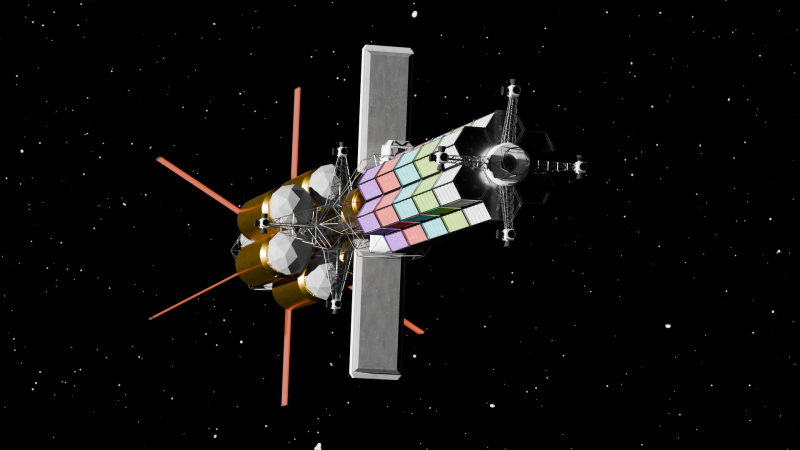


Now with previously-unpublished renders from different camera angles!
This spacecraft, which unfortunately never received a proper make and model, was one of my most complex Blender projects to date. While surpassed in quality by more recent works, it still represents a multi-day effort to provide a suitable vessel for the protagonists of my (shelved) plotline. Immediately visible are the two centrifuge arms, which provide the crew with a variable level of artificial gravity for long-haul flights between planets in a system. Under thrust, they can fold back to account for the lateral acceleration from the main engines: An array of six Direct Fusion Drives, which also provide the main power for the spacecraft while not emitting copious amounts of radiation like most fusion designs. The glowing panels are the radiators, which in defiance to traditional spacecraft design wisdom do not need to be tapered within a radiation shadow, as the exhaust from the engines is not radioactive.
Also visible is the cargo truss, which holds a total of 30 hexagonal containers. While rendering this, I was unable to make it so that each container was a different color than any container bordering it, I was happy with this compromise, and hope to find a solution to this problem in my upcoming works. The truss itself is hollow to allow for inspection of each container, as well as to store smaller payloads, should it be necessary. Aside from the centrifuge, the habitation segment is remarkably scant, with only a cockpit and docking node protruding from the main hull. This render is also notable as this is the only one to date where I modeled an actual cockpit, where an enclosed room with video monitors would suffice. While the latter may be more realistic, especially in the near future as radiation shielding is a critical concern, I reasoned that I could make a small allowance for the sake of aesthetic, as a cockpit with actual windows tends to be more visually interesting from the outside.
To make the cockpit make sense, I placed it so that it would be facing the same direction as the pressurized docking port, with only a few windows facing the direction of travel. I reasoned that this would be an acceptable solution, as docking would necessitate much more direct involvement than simple interplanetary transfers, where the chance of hitting an obstacle is infinitesimal even in an asteroid belt. Nonetheless, the spacecraft also boasts a forward (unpressurized) docking adapter for interstellar transfers, so the forward-facing windows are still somewhat useful.
Add comment
Comments