
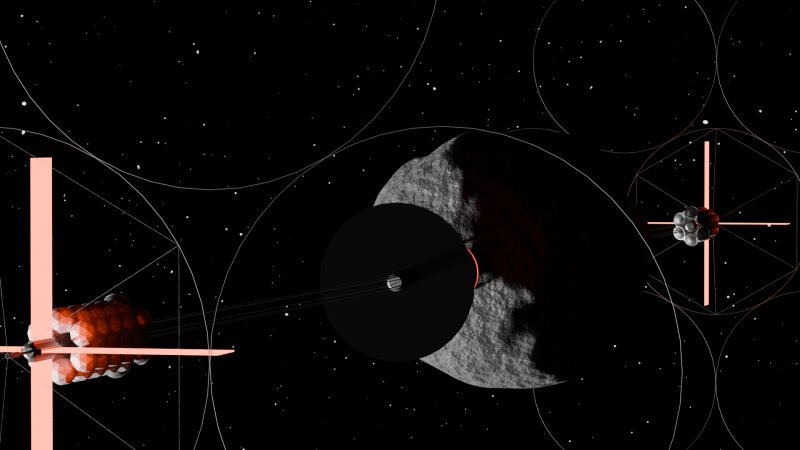
An incredibly massive interstellar ship built around a metallic asteroid.
This ship is by far the largest one I've ever designed. With an approximate length of 54 kilometers, it's certainly nothing to scoff at. The core of the ship is a large metallic asteroid, which has been hollowed out, reinforced, and made into a self-contained habitat similar to an O'Neill Cylinder. While the dream of asteroid spacecraft was largely dashed by recent findings that most asteroids are piles of rubble (as opposed to solid rocks), I reason that an M-Type (metallic) asteroid should be dense enough to be a single solid object, and if not, could be artificially solidified by melting the surface with lasers or solar mirrors.
Extending out from either side of the asteroid are two cylinders, topped by wide radiation shields. These form the cargo storage sections of the spacecraft, which would need to be quite large to sustain a population for sub-relativistic travel between stars. On top of those, connected by a series of tethers (likely made out of carbon nanotube or some other high-strength metamaterial) are two arrays of six massive inertial confinement fusion engines, scaled up versions of those used on the British Interplanetary Society's Daedalus probe. On top of those are the fuel tanks, main radiators, and finally the absolutely humongous MagSail, which pushes on a star's natural stellar wind to start the acceleration out of one system, and the braking into another.
These systems are duplicated for the simple reason that turning such a gargantuan craft would require more fuel than it would take to simply carry a duplicate system. While currently showed in a fully extended configuration, the propulsion segments would likely be retracted depending on the stage of travel.
From a lore perspective, a viewer may be wondering why, in a civilization with wormholes, why anyone would choose to spend upwards of a century in a closed habitat to get from one star to the next. The simple answer is that some people are just like that. It occupies a similar role to those extreme nature retreats, given that human lifetimes have been drastically extended by the 27th Century.
Add comment
Comments